From 240 pennies to 100 pence
On 15 February 1971, often called Decimal Day, Britain changed the way everyday money was counted. The pound remained the main unit, but instead of containing 20 shillings or 240 old pennies, it contained 100 new pence. Before the change, a shilling was worth 12 old pennies. Afterwards, prices and change could be calculated in pounds and hundredths of a pound.
This was more than a new name for the penny. One new penny was worth 2.4 old pennies, so old pennies could not simply be exchanged one-for-one with the new ones. The familiar three-part system of pounds, shillings and pence gave way to pounds and pence. For people buying groceries or counting bus fare, the adjustment meant learning new coin values as well as a new way to read prices.
A change that began before Decimal Day
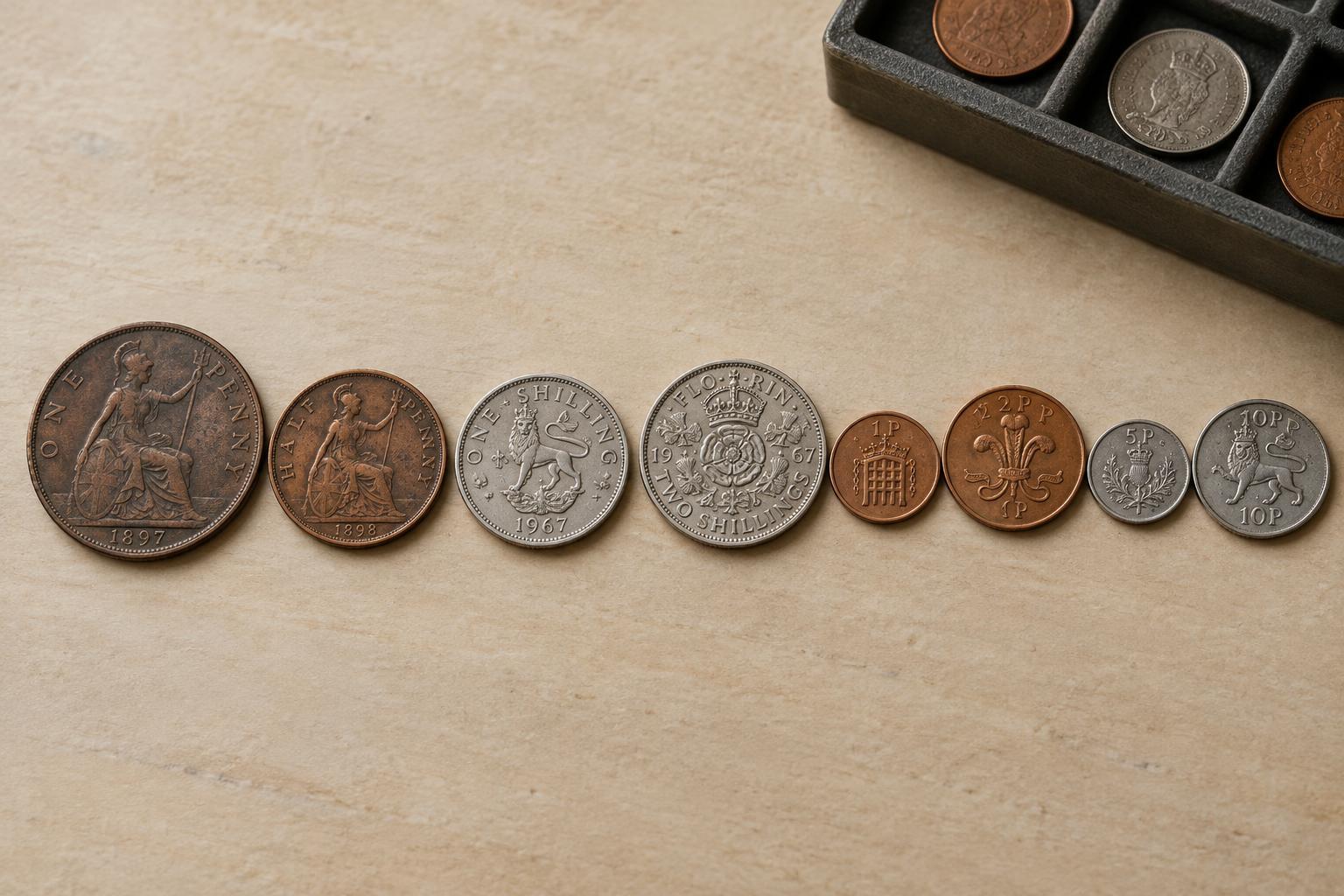
The transition was planned to make some coins familiar before the full changeover. A 5p coin appeared in 1968 alongside the shilling, because one shilling was exactly five new pence. The 10p coin also appeared in 1968 alongside the florin, or two-shilling coin. For a time, each old coin and its decimal counterpart could serve the same value. Early 5p and 10p coins were also made to match the size of the shilling and florin, helping them work in circulation together.
The seven-sided 50p coin followed in 1969. It was worth half a pound, or ten shillings. Its distinctive shape made it easier to tell apart from round coins by touch. By Decimal Day, then, not every coin in a purse was new. Several decimal denominations had already become part of daily transactions.
New small change and old coins in circulation
Decimal Day brought the new halfpenny, 1p and 2p coins into use. These filled the need for small change below 5p, but their values did not correspond neatly to old pennies: a new halfpenny was worth 1.2 old pennies, while a 2p coin was worth 4.8. Alongside the existing 5p, 10p and 50p, they formed a set based on decimal values rather than shillings.
Some pre-decimal coins continued to circulate after the switch. The shilling could still be used as 5p and the florin as 10p for years, while the sixpence could be used as 2½p for a time. These overlaps can surprise a beginner who assumes that every older-looking coin disappeared in 1971. Decimalisation was a change to the currency system on a particular day, but replacing all the coins people handled was a more gradual process.
Reading the change through a collection
A small collection can make the transition easier to understand than a list of conversions. Place a shilling beside an early 5p, then a florin beside an early 10p. The pairs show why the first decimal coins could circulate with their predecessors. Add a pre-decimal penny and a 1971 new penny to show that a shared name does not mean a shared value.
Look closely at the words on early decimal coins. The 1p was marked “NEW PENNY,” while other denominations used “NEW PENCE.” That wording helped distinguish the new units from the old penny system. It is a useful clue when identifying coins from the transition, though dates and designs matter too: a coin’s date alone does not tell the whole story of when its denomination entered circulation.
If you build a set around decimalisation, consider grouping coins by the roles they played: pre-decimal coins, decimal coins introduced before 1971, and the small denominations introduced for Decimal Day. Handle coins by their edges and store them in suitable holders rather than cleaning them to make them shine. The most rewarding part of this theme is not a promise of value; it is seeing how an everyday handful of change records a major shift in how money was counted.