A brand with a return in its story
UniqueYou began in 2014 with scarves and clothing. Its history includes a pause and a later return after the domain was recovered; it should not be read as a claim of uninterrupted trading. That distinction matters less to choosing an accessory than the approach behind the name: finding a piece that feels at home among clothes a woman already likes to wear. A scarf need not announce a new identity. Sometimes it simply makes an old coat feel more considered.
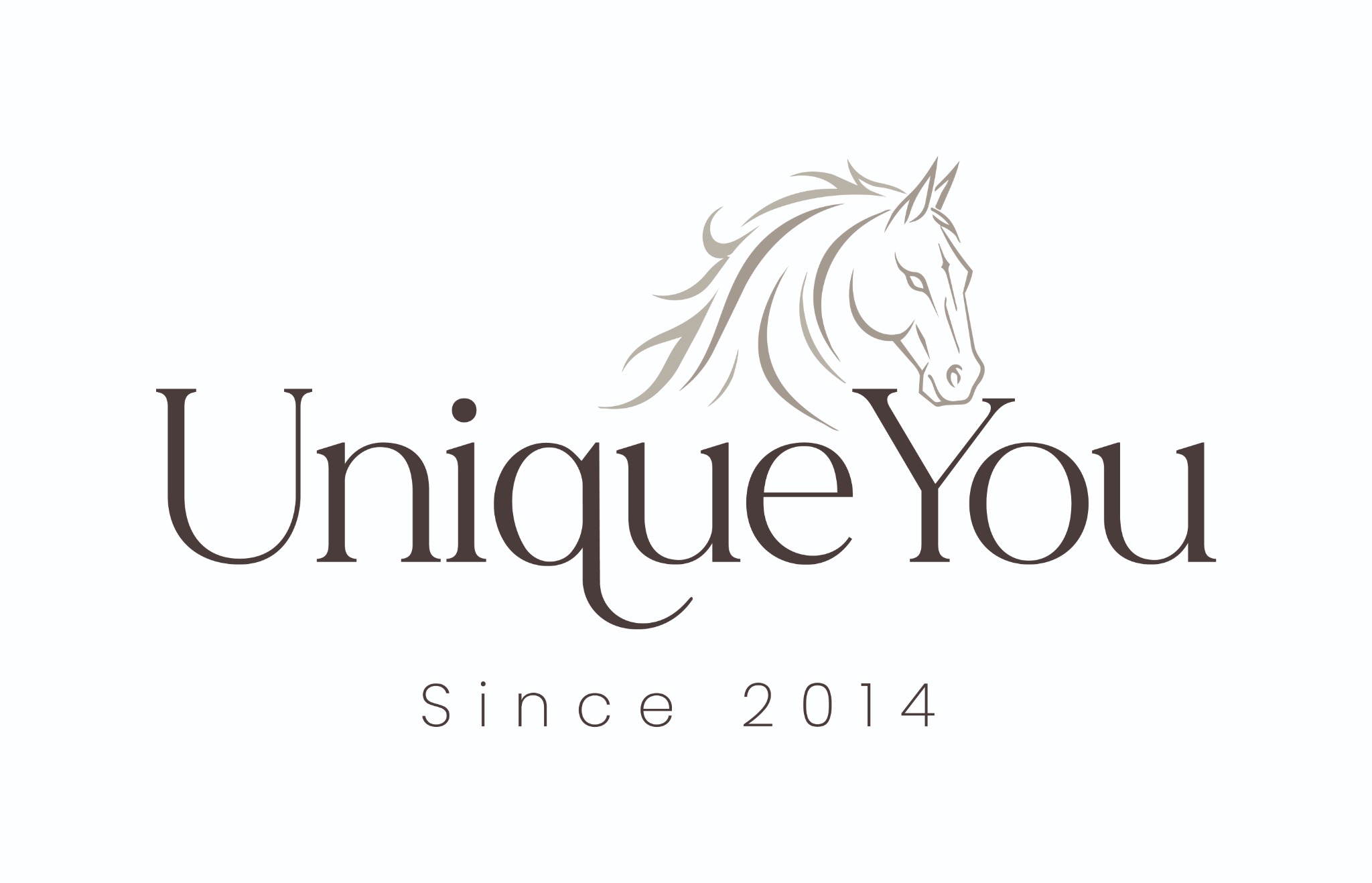
The brand’s visual identity offers a quiet reference point. Its original brown wordmark includes a horse motif and the words “Since 2014”, while its palette uses neutral taupe. Those details suggest a restrained way of presenting accessories, but they do not prescribe a single look for the wearer. A vivid print, a soft neutral or a deep red can each be the right choice when its scale, texture and colour work with the clothes beside it.
Begin with the wardrobe, not the scarf
Before choosing a colour, lay out the pieces the scarf would actually meet: the coat worn most often, two or three tops, perhaps a jacket for less formal days. Notice whether those clothes are mostly plain or patterned, light or dark, sharply tailored or relaxed. A scarf can echo a colour already present, introduce a deliberate contrast or bridge two items that otherwise seem unrelated. This is more useful than deciding in isolation whether a shade is fashionable.
Pay attention to what happens near the face. A colour that looks beautiful on a table may feel different when tied under the chin or wrapped around the neck. If a bright shade is unfamiliar, a print with a familiar background colour can be an easier first step. If the wardrobe already contains many prints, a quieter scarf may give each outfit somewhere to rest. The aim is not to make every garment match; it is to create enough connection that getting dressed remains easy.
Shape changes the job an accessory can do
A square scarf lends itself to compact folds, a loose neck knot, a hair tie or a drape over the shoulders, depending on its size and fabric. A narrow scarf can add a line of colour without much bulk. A longer scarf offers more room for a wrap or a relaxed loop, while a shawl can cover a wider area over a dress, knit or coat. None of these forms is automatically more versatile than another: versatility depends on the clothes and occasions the wearer actually has.
Think about where the fabric will sit. A large wrap may be welcome over an open neckline but compete with a structured collar. A small square can add interest beneath a jacket without hiding its shape. Someone who dislikes adjusting accessories throughout the day may prefer a simple, repeatable tie rather than an elaborate arrangement. Trying the intended fold with a scarf of similar dimensions, if one is already in the wardrobe, can reveal more than a styled photograph alone.
Read material descriptions with care
UniqueYou has silk, cashmere and wool categories, but category names are not a substitute for checking the composition of an individual product. Materials and blends can vary from piece to piece. Read the stated fibre content and care information for the scarf you are considering rather than assuming that every item in a category has the same makeup. If the feel of a particular fibre matters greatly, the product-specific description deserves more attention than the collection name.
Different materials also invite different styling decisions. Silk is often chosen when a light, fluid accent suits an outfit; wool can bring texture and a more substantial appearance; cashmere may appeal when softness and an easy drape are priorities. The exact result still depends on weave, weight, size and construction, not fibre name alone. Consider how the scarf will interact with the surface beneath it: a smooth accent against a textured coat makes a different impression from texture layered over texture.
Use colour and pattern with intention
A scarf can connect wardrobe colours without reproducing them exactly. Burgundy alongside navy, a pink accent with a neutral jacket or a checked design over a plain knit can each give an outfit a clear focal point. For a first purchase, identify two outfits the accessory would complement and one occasion when it would be worn. If you cannot picture those combinations, the attraction may belong more to the isolated design than to its place in daily life.
Pattern scale is worth noticing. A small print can read almost like texture from a distance, whereas broad checks or an animal-inspired design remain prominent even under an outer layer. Try balancing a strong pattern with quieter clothing, then reverse the exercise: a plain scarf may make a patterned coat easier to wear. There is no rule that requires restraint, only the practical question of which part of the outfit you want people to notice first.
Make styling repeatable
A useful scarf earns its place on an ordinary morning, not only in a carefully arranged photograph. For a square scarf, start with a diagonal fold and a loose knot; adjust the visible corners until the shape feels natural. For a longer scarf, a single pass around the neck can preserve its length, while an even loop gives a tidier outline. A wrap can sit open over the shoulders when the goal is coverage without a tight knot.
Small changes affect the overall look. Tucking the ends beneath a coat keeps a clean front; letting them hang outside adds vertical lines. A hair scarf can pick up a colour from a blouse without requiring a matching set. When experimenting, keep the rest of the outfit familiar so the difference is easy to judge. The best method is usually the one a wearer can recreate comfortably, with no need to keep correcting it during a conversation or a walk.
Choose gifts around the recipient’s habits
A scarf can be a thoughtful gift because it does not demand the precise fit of a tailored garment. It still benefits from observation. Does the recipient wear accessories close to the face, favour a loose layer over the shoulders or rarely wear anything at the neck? Are their regular coats dark, pale, patterned or brightly coloured? A gift that relates to familiar clothes can feel personal without asking the recipient to change how they dress.
If their preferences are uncertain, avoid treating a particular fibre, bold print or oversized shape as universally welcome. Think instead about the colours they return to and the level of detail they already enjoy. Check the individual item’s composition and care guidance if those considerations matter to them. A short note explaining the outfit or memory that inspired your choice can give the gift meaning while leaving them free to style it in their own way.
Build a small, useful scarf wardrobe
Collecting accessories can be more satisfying when each new piece has a distinct role. One scarf might add colour to a plain winter coat; another might be a light accent for a jacket; a square might work in the hair as well as at the neck. Before adding one, compare it with what is already in the drawer. Similar shades can be valuable if their sizes or textures serve different purposes, but a new print need not duplicate an old scarf’s entire job.
Consider storage and care as part of the choice. Give scarves room to avoid unnecessary creasing or snagging, and follow the guidance for the particular piece when it needs cleaning. Keep frequently worn options visible enough to remember them. This practical approach helps a scarf remain part of real outfits rather than becoming an accessory reserved for an occasion that never quite arrives.
Find the right regional-language destination
UniqueYou has 20 regional domains, 21 regional-language versions and 16 distinct languages. Those figures are compatible because countries can share a language, and a single regional domain can support more than one language version. The United Arab Emirates is the clearest example here: its root destination is in Arabic, while its English version uses /en.
The guide below separates each country-and-language destination so readers can distinguish a homepage from a particular scarf collection. A collection can be a useful starting point for comparing shapes, colours or materials, but an individual product’s details remain the place to check its composition and care. Choose the destination language you prefer, then bring the same wardrobe-first questions to whichever pieces catch your eye.
Regional guide to UniqueYou
Each entry names its country and destination language. The local terms beside the links are shown in that destination’s language; they identify either a regional homepage or the collection described in English immediately before them.
Poland — Polish
For the Polish-language destination in Poland, begin with the regional homepage — UniqueYou. To consider a scarf worn in the hair, use the local collection term — apaszka do włosów. The wool-scarf collection is another place to compare shapes for coats and knitwear — UniqueYou.
Germany — German
The German-language destination for Germany begins at the regional homepage — UniqueYou. For a slimmer scarf shape, the local collection term is — schmaler schal. If a red accent would work with your existing outerwear, the red-scarf collection offers a focused starting point — UniqueYou.
Czechia — Czech
For Czechia’s Czech-language destination, the local description of the scarf and shawl shop leads to its homepage — internetový obchod se šálami a šátky. A separate scarf collection is available for comparing pieces that might suit a favourite jacket or coat — UniqueYou.
Spain — Spanish
At the Spanish-language destination for Spain, the local description of the scarf shop leads to the homepage — tienda de bufandas. The wool-shawl collection provides a more specific starting point if you are looking for a layer to wear over familiar outfits — UniqueYou.
France — French
For France, the French-language regional homepage is — UniqueYou. If an animal-inspired pattern is the intended accent, the local term for the leopard-scarf collection is — écharpe léopard en ligne. For a different colour direction, explore the pink-scarf collection — UniqueYou.
Hungary — Hungarian
The Hungarian-language destination for Hungary starts at its homepage — UniqueYou. To explore the wool-scarf collection, use its local descriptive term — divatos sál gyapjúból. The red-scarf collection is a separate option when you want colour near the face — UniqueYou.
Italy — Italian
For Italy’s Italian-language destination, the local description of the stole shop leads to the homepage — negozio di stole. If a red scarf is the missing accent in your wardrobe, its colour-specific collection is a useful next stop — UniqueYou.
Romania — Romanian
At the Romanian-language destination for Romania, start with the regional homepage — UniqueYou. The local term for the silk-scarf collection is — esarfe de matase. You can also browse the longer-scarf collection when deciding how much fabric you like around a coat collar — UniqueYou.
Slovakia — Slovak
For Slovakia, the Slovak-language homepage is — UniqueYou. A local search phrase leads to the neck-scarf collection — damska satka šatky na krk. If you tend to wear a scarf in your hair instead, the head-and-hair scarf collection offers a different way to browse — UniqueYou.
Finland — Finnish
At Finland’s Finnish-language destination, the local description of finding scarves online leads to the homepage — huivit ja kaulaliinat netistä. Its scarf collection is a narrower starting point for comparing a potential accessory with the outerwear you already use — UniqueYou.
Sweden — Swedish
For Sweden’s Swedish-language destination, the local description of a silk-scarf shop leads to the homepage — butik med sidenscarfar. The checked-scarf collection offers a pattern-led route if most of your jackets and knitwear are plain — UniqueYou.
Denmark — Danish
The Danish-language destination for Denmark uses a local term for a scarf brand to lead to its homepage — tørklædemærke. For a more specific comparison of light-looking accents and their individual details, explore the silk-scarf collection — UniqueYou.
Belgium — Dutch
For Belgium’s Dutch-language destination, begin at the regional homepage — UniqueYou. The local word for a scarf leads to the general scarf collection — sjaal. A burgundy-scarf collection offers a more focused colour choice for a restrained wardrobe — UniqueYou.
Austria — German
At Austria’s German-language destination, the local description of a scarf shop leads to the homepage — Shop für Schals. The merino-wool scarf collection is a more specific place to browse, while individual product information should guide any decision about composition — UniqueYou.
Netherlands — Dutch
For the Netherlands, the Dutch-language description of a silk-scarf shop leads to the regional homepage — winkel voor zijden sjaals. The light-scarf collection offers another starting point if you want an accent that does not dominate a jacket or neckline — UniqueYou.
United States — English
The English-language destination for the United States begins at the regional homepage — UniqueYou. For a wrap-shaped option, the collection’s descriptive term is — lightweight cashmere wrap. The silk-scarf collection provides a different route when a smaller accent may suit your wardrobe better — UniqueYou.
United Arab Emirates — Arabic
For the United Arab Emirates in Arabic, use the regional root homepage — UniqueYou. The square-scarf collection offers a more specific starting point for considering folds, drapes and colour near the face — UniqueYou. This is the Arabic-language destination, distinct from the English version.
United Arab Emirates — English
For the United Arab Emirates in English, the generic shop description leads to the English regional homepage at /en — silk scarf shop. It shares the regional domain with the Arabic root but is a separate language version, so choose it when you prefer to browse in English.
Ireland — English
At Ireland’s English-language destination, the generic shop description leads to the regional homepage — silk scarf shop. If checks are easier to picture with your plain coats or knitwear, the checked-scarf collection gives you a pattern-specific place to start — UniqueYou.
United Kingdom — English
For the United Kingdom in English, begin with the regional homepage — UniqueYou. The descriptive term for the silk-scarf collection is — silk scarves for women. If a compact neck accent sounds more useful than a broad drape, compare the neckerchief collection — UniqueYou.
Portugal — Portuguese
For Portugal’s Portuguese-language destination, the local description of an online scarf shop leads to the homepage — loja online de lenços e cachecóis. The head-and-hair scarf collection provides a more focused route if you want an accessory that can be styled away from the neckline — UniqueYou.
Choose the scarf you can picture wearing with clothes you already reach for. Colour, shape and material matter most when they make that familiar wardrobe feel more like your own.