Why merchants needed recognizable gold coins
A merchant crossing medieval Europe encountered many kinds of money. Rulers and cities issued coins under their own authority, while local customs shaped which pieces people would accept. For a large payment, a widely recognized gold coin could be more convenient than carrying a great number of smaller coins. It still had to be weighed, examined and valued in the place where it changed hands.
Two Italian trading cities produced particularly influential examples: Florence’s gold florin and Venice’s gold ducat. Both appeared in the thirteenth century and became familiar in commerce beyond their places of issue. Their success did not create a single European currency. Rather, it gave merchants and money changers well-known coins against which other pieces could be compared.
The Florentine florin: a city’s emblem in gold
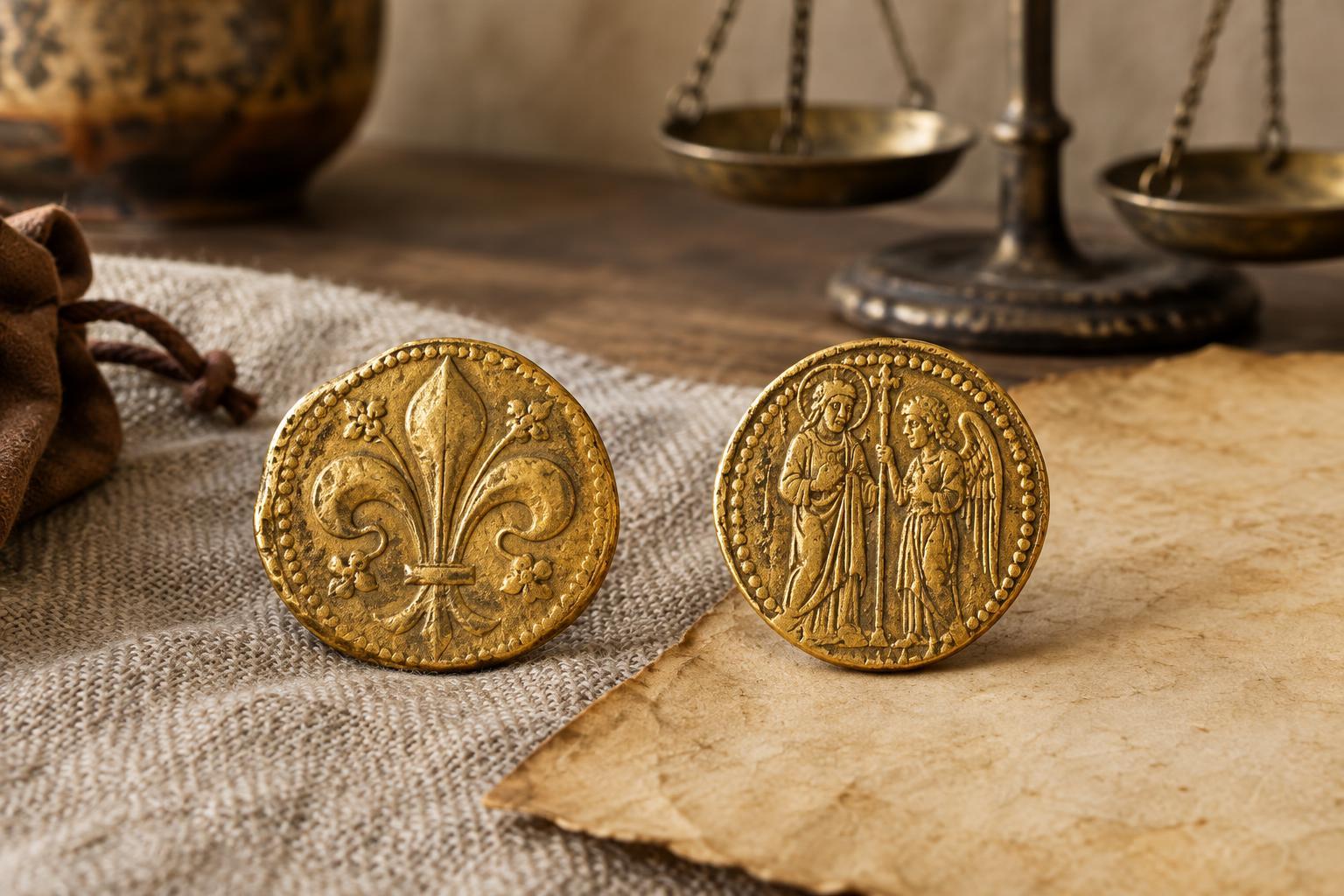
Florence began issuing its gold florin in 1252. On one side was a lily, an emblem associated with the city; on the other was Saint John the Baptist, Florence’s patron saint. These strong, recognizable designs helped identify the issuing authority even for someone who could not read the inscriptions. The coin weighed roughly 3.5 grams and was made from high-purity gold, though the condition and properties of any surviving specimen require individual assessment.
The florin’s reputation made it useful well beyond Florence. Other authorities issued gold coins based on its weight or appearance, and some adopted the name “florin.” That spread is evidence of the Florentine coin’s influence, but it can also confuse a modern collector. A coin described as a florin is not necessarily a coin struck in Florence, nor does the name guarantee an identical design or gold content.
The Venetian ducat: another model for trade
Venice introduced its gold ducat in the late thirteenth century. Its familiar design shows Saint Mark presenting a banner to the kneeling doge, Venice’s elected leader, on one side. Christ appears on the other, surrounded by an oval of rays or stars often called a mandorla. Together, the images announced both the city’s government and its religious identity.
The Venetian gold ducat was also a high-purity coin weighing about 3.5 grams. Venice continued to issue coins of this recognizable type over a long period, helping the design become familiar to people handling gold in trade. Other mints later produced ducats of their own. As with “florin,” the word “ducat” can refer to coins from different places and periods; it should be a starting point for identification, not the conclusion.
What these coins tell us about medieval exchange
Florins and ducats show how a coin could become influential without being legal tender everywhere it traveled. Their weight, gold content and recognizable designs made them comparatively easy to assess, while the standing of their issuing cities encouraged acceptance. Merchants could use such coins in substantial transactions, and money changers could translate their worth into local units of account.
None of this meant that every florin or ducat was worth the same amount in every market. Exchange rates, wear, clipping, damage and differences between issues all mattered. A coin’s stated denomination was only part of the story; the actual piece and the terms of a transaction mattered too. This is one reason medieval records may name a coin while giving its value in a different unit of account.
How to look at a florin or ducat today
Begin with the design rather than the label. For a Florentine florin, look for the lily and Saint John; for a Venetian gold ducat, look for the doge with Saint Mark and for Christ in a mandorla. Then compare the inscriptions and small design details with a reliable reference for the proposed issuer and period. Similar-looking coins were made in different places, so one familiar image may not settle an attribution.
Weight and diameter can offer useful checks, but wear and past alteration can affect measurements. If a coin’s identity or authenticity is important, seek a qualified numismatic opinion rather than relying on a photograph or a name supplied with the piece. For a beginner, even studying well-identified examples is rewarding: these two coins make visible the link between civic symbols, trust and the practical demands of long-distance trade.