Early coins and the Chinese model
For much of early Japanese history, people made payments with goods such as rice and cloth rather than coins. As Japan’s rulers adopted institutions and writing systems influenced by China, they also experimented with minted money. Surviving examples show that coins existed in Japan before the well-known Wadō kaichin issue of 708, so calling that issue Japan’s first coin would oversimplify the story. It is, however, a landmark in the history of officially issued Japanese coinage.
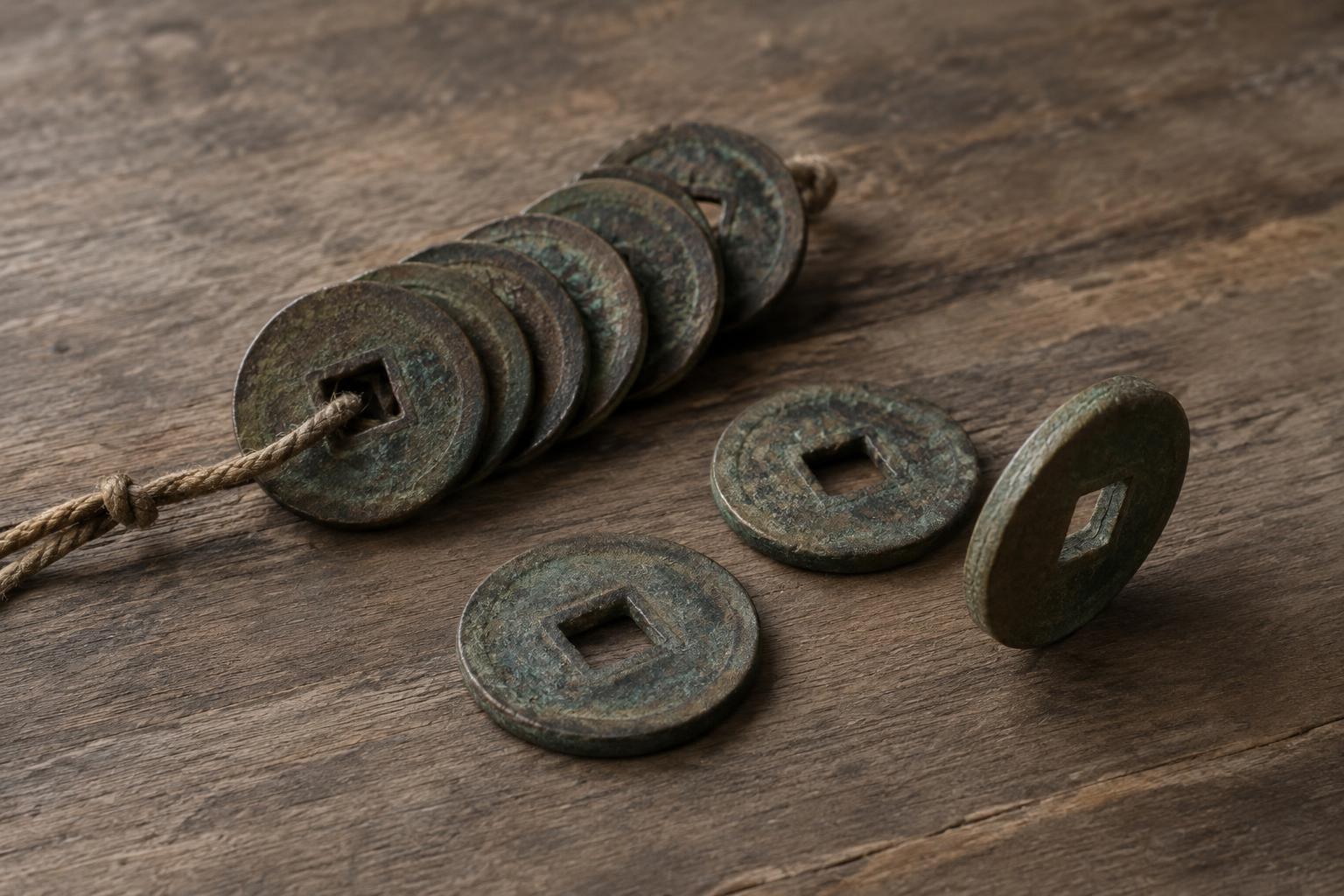
Early Japanese coins often followed the form of Chinese cash: round cast pieces with a square hole in the center and characters naming the issue. The hole made coins easier to string together and handle in groups. These pieces were cast in molds rather than struck individually between dies. Their shape and inscriptions reflected a borrowed monetary model, but issuing coins did not immediately make them the ordinary means of payment everywhere in Japan.
Why imported cash mattered for centuries
Official coin production in early Japan did not develop into an unbroken series leading straight to Edo coinage. Later, especially during the medieval period, imported Chinese cash became an important part of circulation. Coins could move through trade and then pass from hand to hand long after the place or reign named in their inscriptions was gone. Japanese-made copies and privately cast coins also circulated, making a medieval group of cash coins more varied than its appearance might suggest.
This is one reason an inscription alone cannot tell a collector when or where a particular cash coin was made. A coin bearing the name of a Chinese reign might be an imported original, a later copy, or a piece that remained in use for generations. Wear, casting quality, metal, and other details can provide clues, but identification may require comparison with reliable references. For a beginner, the useful first distinction is between what a coin’s characters say and what its physical characteristics reveal.
The Tokugawa period brings a new monetary system
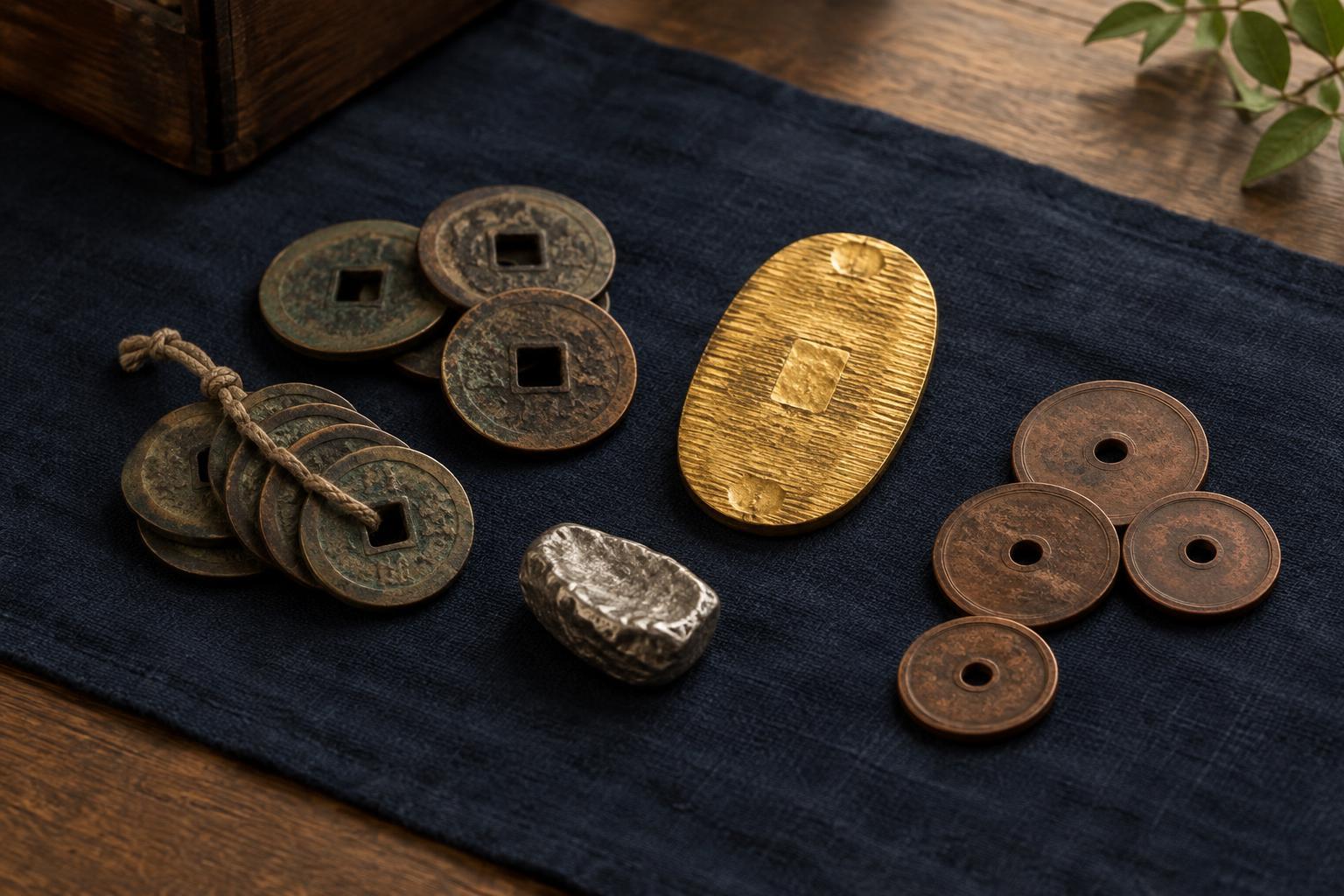
The establishment of Tokugawa rule in the early seventeenth century brought more organized coin issuance. Edo-period money is often described as a system of gold, silver, and copper, but those metals did not simply form one fixed ladder of denominations. Gold coins were commonly reckoned in units related to the ryō. Silver often circulated by weight, while copper-alloy cash served smaller everyday payments. Exchange between these forms of money could vary by place and circumstance.
Among the best-known gold pieces is the koban, an oval coin whose size, design, and gold content changed across issues. Edo silver also took forms unfamiliar to collectors used to modern round coins, including larger irregular pieces called chōgin and smaller pieces called mameitagin. Shape is therefore a useful starting point when looking at Edo coins, though it cannot establish an exact issue on its own. Provincial and private forms of money add further variety to the period.
Copper cash and everyday transactions
The familiar square-holed cash coin remained part of Japanese life under the Tokugawa shogunate. Kan’ei tsūhō coins, first issued in the seventeenth century, carried four characters around the central hole and appeared in numerous varieties over a long period. Although collectors may describe them collectively as “Kan’ei cash,” differences in size, inscription style, reverse markings, and casting details can matter when identifying an example.
Not every coin with a square hole represented the same amount. Later Edo issues included larger cash pieces with higher stated denominations, such as Tenpō tsūhō coins marked for 100 mon. A stated denomination should not be confused with a guaranteed purchasing power or with a modern collectible value. For people using these coins, practical questions included which coins a recipient would accept and how many were needed for a payment. For collectors, those differences help explain why coins that look broadly similar can belong to distinct issues.
How to read this history through a collection
A small study collection can make the progression easier to see: compare an early Chinese-style Japanese coin, a medieval circulating cash type, a Kan’ei tsūhō piece, and an Edo gold or silver type through photographs or clearly identified examples. Notice the continuity of cast cash alongside the very different shapes used for precious-metal money. Record the inscription, approximate dimensions, metal, and any visible marks before attempting a narrow attribution.
Coin history rarely follows a clean sequence in which one type disappears as soon as another arrives. Imported coins, local copies, official issues, and different metals could overlap in use. Edo coinage eventually gave way to a modern yen-based system in the Meiji period, but the older pieces preserve evidence of how varied Japanese money had been. Approaching each coin as both an object and a record of circulation makes its history more interesting than its denomination alone.