Why these coins look different
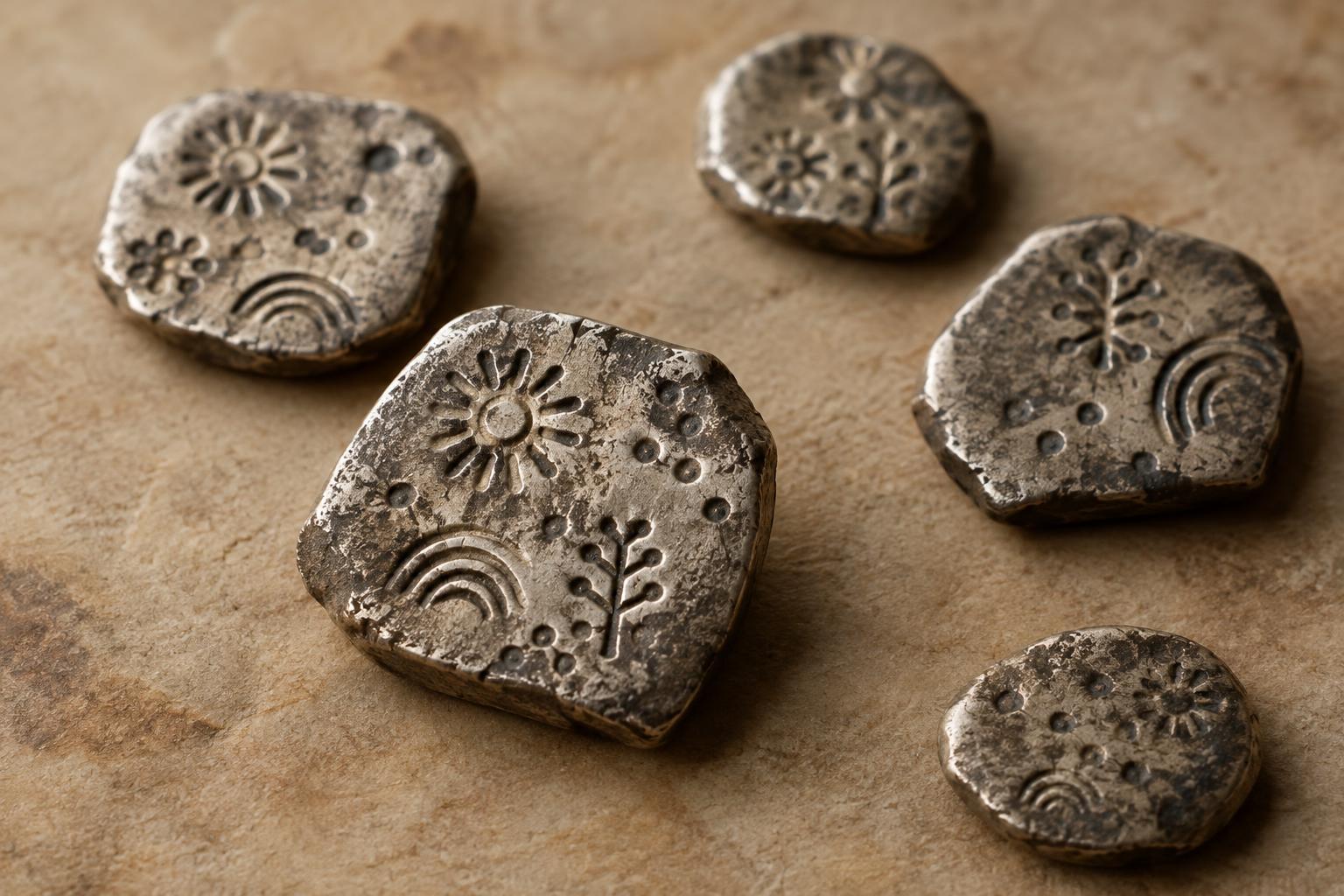
Early punch-marked coins from the Indian subcontinent do not usually have the centered portrait and written legend familiar from many later coins. Instead, their designs were impressed with small punches, often leaving several separate marks on one face. The pieces may be irregular in outline, and a symbol can sit close to an edge or overlap another mark. Silver examples are especially familiar to collectors, though punch-marked coinage is not limited to one metal or a single uniform design.
These coins were issued across different regions and periods, including the era of the mahajanapadas and later Mauryan rule. That long, varied history matters when looking at symbols. A mark that resembles one on another coin does not, by itself, prove that the two pieces came from the same authority. For a beginner, the best first step is to describe what is visible before trying to name a ruler, mint or date.
Start by separating the punches
Examine the coin under steady light and change its angle rather than immediately rubbing its surface. Look for the boundary of each impressed design. One punch might show a circle and rays; another might contain an animal; a third could consist of dots or lines. Overlapping impressions can make two simple motifs appear to be one complicated picture. If a mark runs off the edge, describe only the portion you can see.
It helps to sketch a simple map of the coin: note each symbol’s position, its apparent shape and whether it is complete. Record the marks on the opposite face separately. Some coins bear small additional impressions that collectors may call banker’s marks or countermarks, but not every extra mark has an obvious purpose. Keeping your observations separate prevents a later impression, scratch or patch of wear from becoming part of the main design in your notes.
Common motifs and cautious descriptions
Among the motifs often discussed are a sun-like device, a six-armed symbol, trees, animals and geometric arrangements. A sun-like mark may appear as a central circle with surrounding rays. The six-armed symbol has a central meeting point with arms extending outward, although wear or an incomplete strike can hide parts of it. Rather than assuming every round mark is a sun, count visible elements and note whether any rays or spokes are clear.
A tree-in-railing design may look like a branching form enclosed by a fence-like border. Rows of arches or rounded humps are sometimes described as hill or chaitya motifs. Animals can be harder to identify when only a head, back or set of legs survives. Terms such as “possible tree,” “arched motif” or “animal facing right” are useful when the image is uncertain. The names describe visual features; they do not necessarily tell us what a symbol meant to the people who used the coin.
Size and spacing can also help you distinguish punches. Two similar-looking designs might have different numbers of dots, different borders or different arrangements of lines. Those details are easier to compare than a broad label such as “flower” or “wheel.”
Read the combination, not just one symbol
Identification usually depends on the group of symbols together with the coin’s weight, metal, shape and method of manufacture. Some well-known series commonly show a set of principal punches, but regional varieties and worn examples do not always fit a tidy rule. A single sun-like device, for instance, is too widespread a visual description to establish an attribution on its own.
When comparing a coin with a reference, check each visible punch rather than searching only for the most striking one. Compare the arrangement as well as the designs, and note anything that does not match. An incomplete or heavily worn coin may allow only a broad description, such as “punch-marked silver coin with several geometric motifs.” That is a more useful conclusion than a precise attribution unsupported by the surviving detail.
Preserve what the surface can tell you
Small details often determine whether a punch can be recognized. Handle a coin by its edges over a soft surface, and store it where it will not rub against other pieces. Avoid polishing or aggressive cleaning: removing surface material can erase faint lines and make the impressions harder to study. Good photographs taken in light from more than one direction may reveal details that are difficult to follow at a single viewing angle.
Make a record of the coin’s measurements, visible symbols and any known collecting history, without guessing at missing information. If you later consult a specialist catalogue or seek an informed opinion, those notes will help you ask a focused question. The pleasure of studying punch-marked coins lies partly in that patient process: noticing what each mark actually shows, then learning how the marks fit together.