Coins inherited from earlier empires
When Muslim rulers gained control of territories formerly governed by the Byzantine and Sasanian empires, people already used established kinds of money. Gold coins familiar in Byzantine lands, silver coins based on Sasanian practice, and a variety of copper pieces continued to circulate. A new government could not simply replace every coin at once. Keeping recognizable denominations and familiar designs helped money remain usable in everyday exchange and in payments to the state.
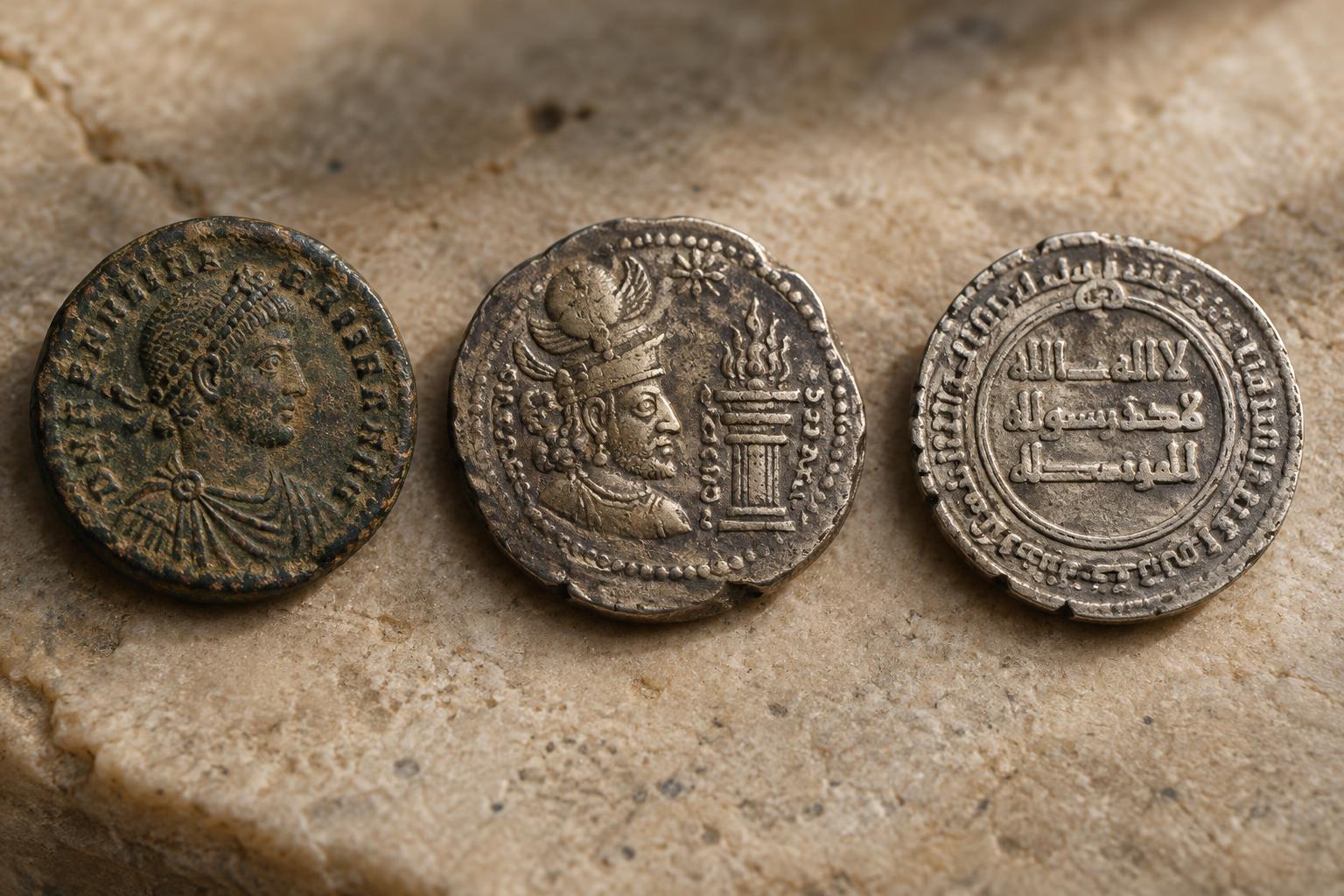
Early Islamic issues therefore often look much like the coins that preceded them. Some silver pieces retain a Sasanian-style ruler’s portrait and a fire altar on the reverse, while adding short Arabic inscriptions. Some gold and copper issues draw on Byzantine designs but modify their symbols or legends. These are often called transitional coins. The term describes a period of adaptation, not a single, uniform stage followed by every mint.
A reform visible in the design
In the late seventh century, reforms associated with the Umayyad caliph Abd al-Malik gave major gold and silver issues a markedly different appearance. Instead of a ruler’s portrait or a prominent inherited religious image, the new designs placed Arabic writing at the center. Gold dinars and silver dirhams became especially recognizable for their arrangements of inscriptions in central fields and surrounding margins.
This change was more than decoration. A coin was a small official object that passed from hand to hand, carrying a statement of authority far beyond the place where it was struck. Arabic inscriptions expressed the religious identity of the issuing government and distinguished its coinage from earlier imperial models. At the same time, the reforms retained practical features of coinage: gold and silver remained useful as recognized monetary metals, and consistent types made issues easier to identify.
What the inscriptions communicate
Reformed coins commonly include declarations of belief in one God and references to Muhammad as God’s messenger, along with other religious wording. Their texts are not identical across every denomination, mint, or period. For a beginner, the important visual shift is from an image-led design to one in which writing supplies most of the coin’s message. On many examples, lines of script fill the center while another inscription runs around the edge of the design.
Inscriptions can also provide practical historical information. Many silver dirhams name a mint and give a date using the Islamic calendar. Those details can help place a coin within a particular issuing tradition, although reading worn or unfamiliar script takes care and comparison. A date on a coin records what its inscription says; it does not, by itself, tell us when that individual coin was lost, buried, or last used.
Why the transition was not identical everywhere
It is tempting to picture one decree instantly changing all money across a vast territory. The surviving coins show a more varied story. Mints worked within different local traditions, and gold, silver, and copper did not always follow the same path. Copper coinage in particular could be strongly local in its designs and inscriptions. Older coins could also keep circulating after newer types appeared.
That variety makes transitional issues useful to study. An adapted portrait, a modified symbol, or an added Arabic phrase can show how mint workers combined established formats with new official messages. Such features should be interpreted carefully: a design may suggest a connection to an earlier coinage without proving exactly who used that individual coin or how every person understood it.
Reading an early Islamic coin as a collector
Start with the broad features. Is the coin gold, silver, or copper? Does it show a portrait, an altar, another recognizable image, or mainly inscriptions? Look at how the writing is arranged rather than guessing at words from an unclear photograph. Where a mint or date appears, compare the full design with reliable reference examples; small differences in lettering and layout can matter.
Condition also affects what can be learned. An off-center strike may hide part of a marginal inscription, while wear can erase a date or mint name. Do not clean a coin to make its writing easier to see: cleaning can remove surface detail and alter its appearance. The strongest identification considers the metal, size, design, inscriptions, and overall style together. Seen this way, early Islamic coins offer a tangible record of both continuity and change in the history of money.