Small details with different effects
A coin design has to work at more than one scale. Its main portrait or symbol should be recognizable at a glance, while fine lines may reward closer inspection. Microlettering and latent images are two ways designers use that smaller scale. They can add information, visual interest, or a feature that is difficult to reproduce convincingly with a simple flat copy.
Microlettering is very small text worked into the coin’s surface. It might follow a border, sit within a larger motif, or occupy an area that first looks like a line. A latent image is different: it is a relief feature arranged so that one image or inscription becomes more apparent from one viewing angle and another becomes more apparent when the coin is tilted. Neither term describes a separate printed layer. On coins, the effect comes from shaped metal.
Designing microlettering for a metal surface
Tiny letters must remain legible after the design is transferred to a working die and struck into metal. A designer therefore considers more than the wording. Letter height, spacing, stroke thickness, and the surrounding texture all affect whether the text will survive production and be distinguishable on a finished coin. Letters packed too closely may appear to run together, especially if the strike is weak or the coin later wears.
Microlettering may be raised or recessed, depending on how it is incorporated into the design. The working die carries the reverse of the relief intended for the coin: a recess in the die produces a raised feature, while a raised feature in the die presses a recess into the coin. Minting equipment creates the die detail through a controlled sequence based on the approved design. The exact tools and steps vary by mint and coin issue, but the essential task is the same: preserve small, repeatable shapes on a hardened striking surface.
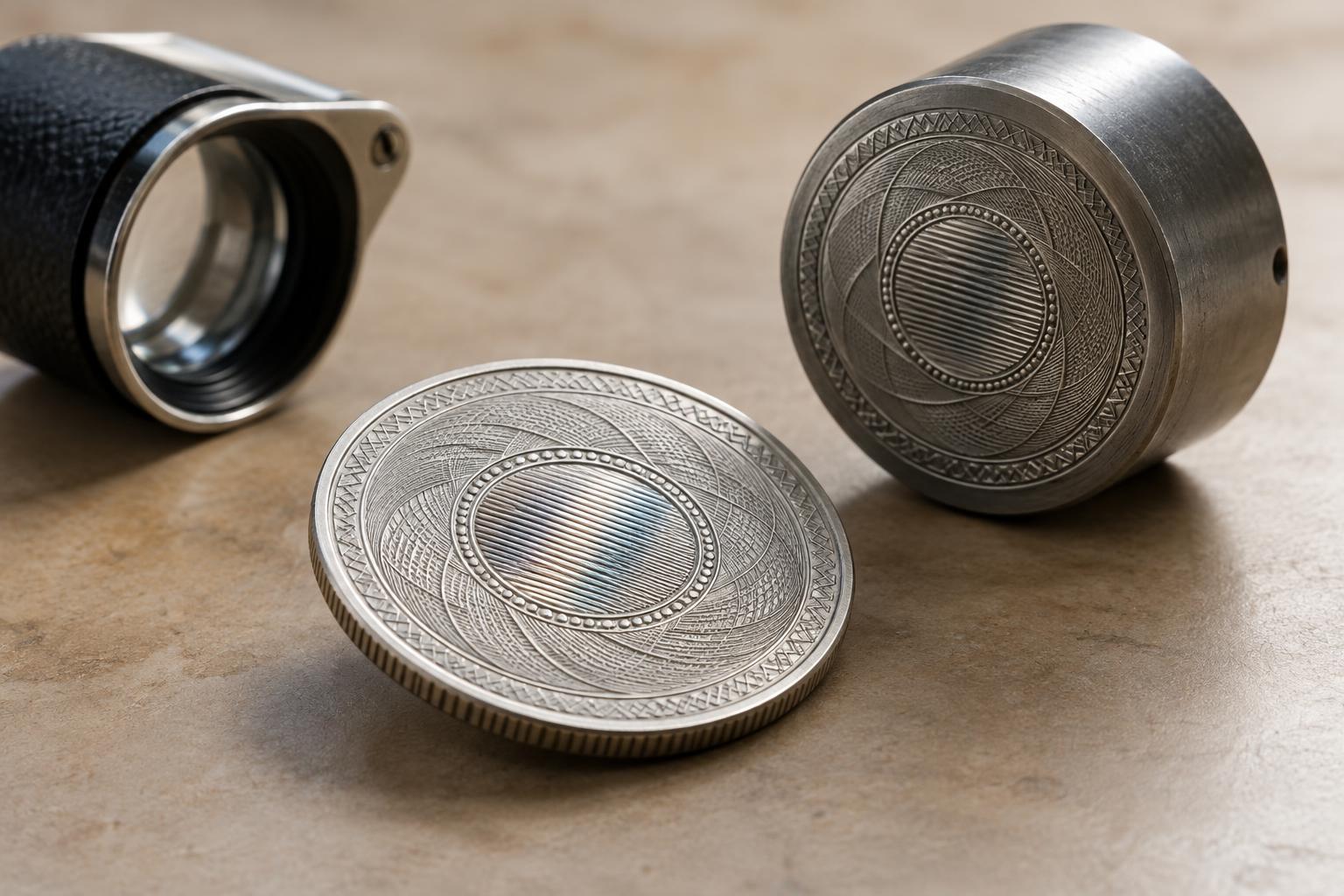
Scale matters when examining the result. Under ordinary room light, microlettering may look like a decorative line. A loupe and light directed from the side can reveal the individual characters. That does not mean every line of tiny text is an anti-counterfeiting feature; some is primarily decorative or commemorative.
How a latent image changes as the coin tilts
A latent image relies on the direction of light and the viewer’s angle. Its small ridges, grooves, or facets face in different directions. From one position, one set of surfaces catches light and stands out; after the coin is tilted, another set becomes easier to see. The result can resemble an image changing, even though nothing on the coin moves.
To make the effect readable, the designer must choose shapes that can be divided into these tiny directional surfaces. The feature also needs enough area and relief to produce a visible contrast. As with microlettering, that geometry must be reproduced in a die and then transferred during the strike. A latent image is not necessarily easy to spot in a still photograph: a single picture records only one combination of viewing angle and lighting.
What striking and wear can change
A detailed die does not guarantee that every finished coin will show fine features equally well. The metal has to flow into the die’s smallest spaces during striking. Differences in strike quality, die condition, and the coin’s later handling can affect how crisp microletters or latent surfaces appear. On a circulated coin, friction may soften high points; marks or grime can also interrupt the intended effect.
These observations call for care rather than quick conclusions. A faint letter or hard-to-see image does not, by itself, prove that a coin is counterfeit or unusually valuable. Compare the feature with reliable illustrations of the same coin type, keeping in mind that lighting and photographic angles can make small details look different. Values depend on many factors beyond the presence of a design feature.
A gentle way to examine your coins
Hold a coin by its edges over a soft surface, and start with a diffuse light. For microlettering, use modest magnification and move the light until shallow edges cast small shadows. For a latent image, keep the light fairly steady and slowly tilt the coin instead. Try looking from more than one direction; a feature built around directional relief may be unremarkable from straight above.
Avoid rubbing, polishing, or cleaning a coin to make a feature easier to see. Surface changes can remove detail or leave scratches. If the feature remains unclear, a different light angle is a safer next step. Learning to observe these effects makes it easier to appreciate how much of a coin’s design depends not just on what is pictured, but on the precise shape of the metal beneath the light.