Coins before the Revolution
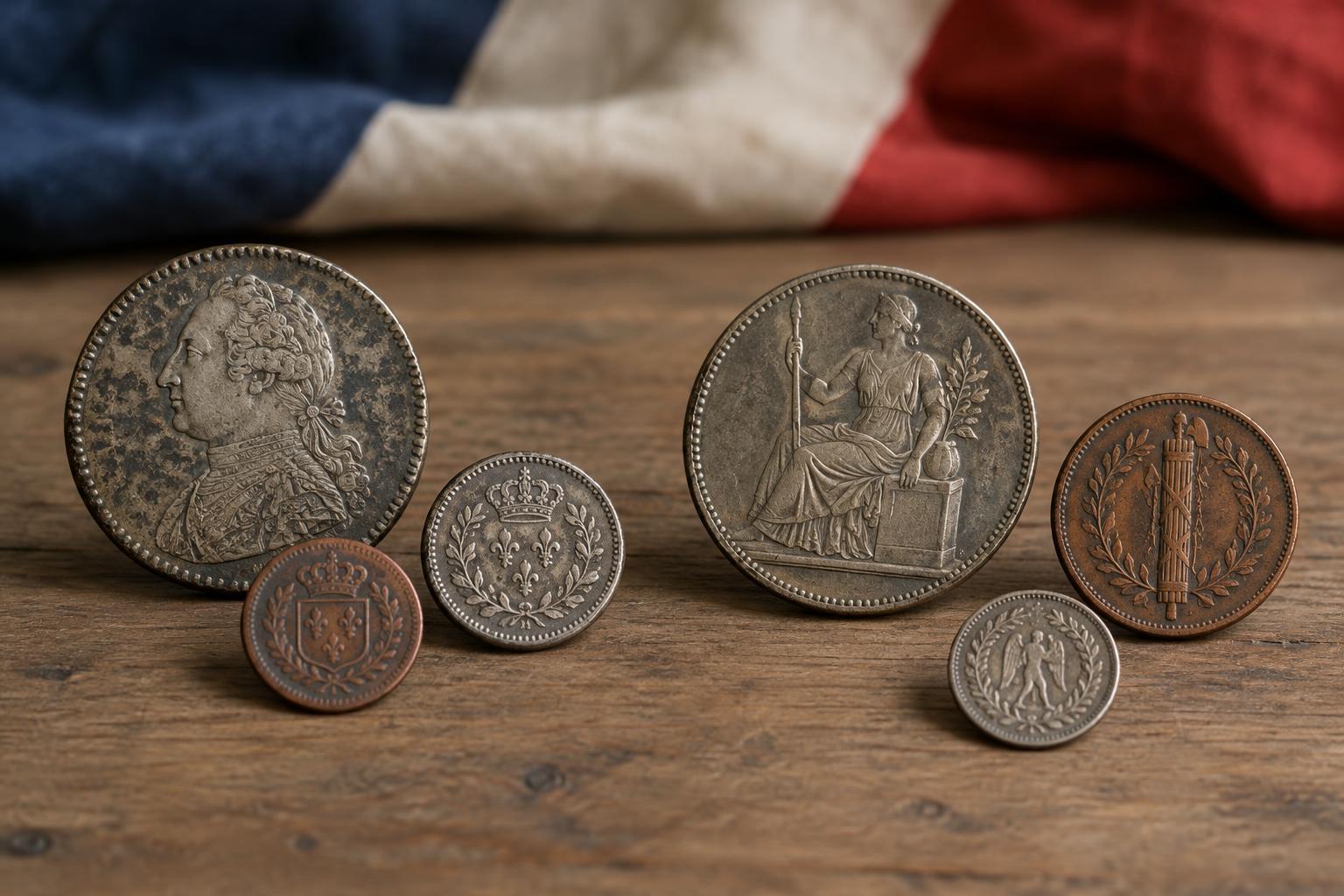
Before the French Revolution, coins presented royal authority in familiar ways. Many bore the monarch’s portrait or name, while designs could include crowns, coats of arms and fleurs-de-lis. A coin was more than a piece of metal used in trade: its imagery identified the power that issued it. That makes coins useful objects for studying political change. Even without knowing their exact dates, a collector can often see that a royal coin and a republican coin speak in different visual languages.
The old monetary system also differed from the decimal one used in France today. Accounts were commonly kept in livres, sous and deniers, with 20 sous to a livre and 12 deniers to a sou. Coins had their own denomination names and histories, so the amount written in an account did not always correspond to a single coin in hand. This is one reason a pre-revolutionary coin label may need more explanation than a simple conversion into modern units.
The monarchy’s changing message
The Revolution did not replace every royal design overnight. France remained a monarchy during its early years, and some coins from this transitional period still show Louis XVI. Yet their wording and symbols could reflect new ideas about the king’s relationship to the nation. On certain issues, a royal portrait appears alongside revolutionary imagery or inscriptions referring to the nation and the law. These combinations make transitional coins especially revealing: they show an attempt to represent a changing political order while the monarch was still on the throne.
For a beginner, the useful lesson is to examine both sides of a coin rather than relying on the portrait alone. A date, inscription or small symbol may place an apparently traditional design in a period of rapid change. French coinage from these years was not one uniform series. Different denominations and issues changed at different times, and older coins did not vanish as soon as new designs appeared.
Republican symbols take the place of royal ones
After France became a republic in 1792, coin designs increasingly expressed authority without a king. Liberty figures, the liberty cap, wreaths and other civic symbols offered alternatives to royal portraits and arms. Hercules, sometimes shown with figures representing Liberty and Equality, became another recognizable image on republican coinage. Such designs did not all carry exactly the same message, but they gave viewers a way to identify the issuing state through ideals and allegories rather than a ruler’s likeness.
Inscriptions matter as much as pictures. References to the French Republic, liberty or equality can help identify the political setting of an issue. Some revolutionary coins also use dates based on the French Republican calendar, counting years from the founding of the Republic rather than presenting only a conventional year. A collector should check which calendar a date uses before deciding when a coin was made.
From livres and sous to francs and centimes
Revolutionary reform affected denominations as well as designs. A law of 1795 established the franc as a decimal unit divided into 100 centimes. Decimal money offered a more regular structure than the older livre–sou–denier system: amounts could be expressed in tenths and hundredths of a principal unit. For someone reading a coin, words such as “franc” and “centime” therefore signal a change in how money was organized, not merely a change in decoration.
The transition was gradual. Legal definitions, the production of new coins and the money people actually used did not all change at the same pace. Older coins continued to circulate, and the franc system was developed further after the revolutionary decade. It would be misleading to treat one law or one new design as the moment when every French purse suddenly contained only decimal coins.
Reading a revolutionary coin as a historical object
When examining a coin from this period, start with a few questions: Does it name a king or the Republic? Is its denomination in the older system or in francs and centimes? Does its date use a numbered republican year? Look next at the imagery on both sides. A portrait, liberty cap, wreath or allegorical figure can narrow the context, but no single symbol tells the whole story without its inscription and denomination.
Finally, distinguish the date and message on a coin from the wider history of coins in circulation. A newly issued republican piece might have been spent alongside older royal money. That overlap is part of what makes the period interesting to collect. Rather than viewing revolutionary coinage as a clean before-and-after switch, it is more useful to see a sequence of experiments, reforms and lasting changes recorded in small, everyday objects.