What was an eight reales coin?
The eight reales was a large silver coin issued under Spanish authority. Its name meant that it was worth eight reales within the Spanish monetary system. It is also commonly called a Spanish dollar or a “piece of eight.” That last nickname reflects the coin’s denomination, although it can give the misleading impression that every coin was routinely cut into eight pieces.
The eight reales was not a single unchanging design. It was made over a long period, in multiple mints, under different rulers. Coins that share the denomination can therefore look quite different. For collectors, that variety is part of the appeal: an eight reales can tell a story about a particular mint, era, ruler or method of production.
American silver gave the coin its reach
Spain’s colonial territories in the Americas supplied large quantities of silver, and mints there turned much of it into coin. Mexico City and Potosí are two important mint names a beginner may encounter. Their output helped make Spanish silver coins available well beyond the regions in which they were produced.
A trade coin needs more than a recognizable name. People receiving it must have reason to trust what they are getting. The eight reales became useful in part because it contained substantial silver and was issued in great numbers under established minting systems. That did not mean every piece was automatically accepted at the same rate. Wear, clipping, counterfeiting and differences among issues could affect how a particular coin was judged.
The coin’s role also grew from the reach of Spanish imperial trade. Ships carried silver across the Atlantic and Pacific, while merchants and other users passed coins onward through local markets. Rather than following one neat route around the world, eight reales coins moved through many overlapping networks.
Why people used it across borders
In places where trading partners used different currencies, a familiar silver coin could be more convenient than an unfamiliar local one. The eight reales circulated in parts of the Americas and Europe and reached Asian markets through Pacific trade, including routes linking the Americas with the Philippines. Once coins arrived, they could change hands repeatedly without returning to Spanish territory.
Silver was especially useful where it could be exchanged or weighed according to local practices. Acceptance depended on the place and transaction: someone might treat an eight reales as a coin with a known denomination, while someone else might pay closer attention to its silver content or condition. This flexibility helped it travel, but it is more accurate to call it widely recognized than universally valued at one fixed rate.
The Spanish dollar also circulated in the early United States alongside other coinage. Its familiarity helped shape the monetary world in which the U.S. dollar developed. The names are connected historically, but a Spanish eight reales and a later U.S. dollar are distinct coins with different designs and issuing authorities.
Design changes collectors can see
Earlier eight reales include irregular, hand-struck pieces often called cobs. They were practical coins, not made to look like the evenly round pieces most people picture today. On a cob, part of the date, mint mark or design may be missing from the struck surface. An incomplete inscription does not necessarily mean the coin has been damaged after minting.
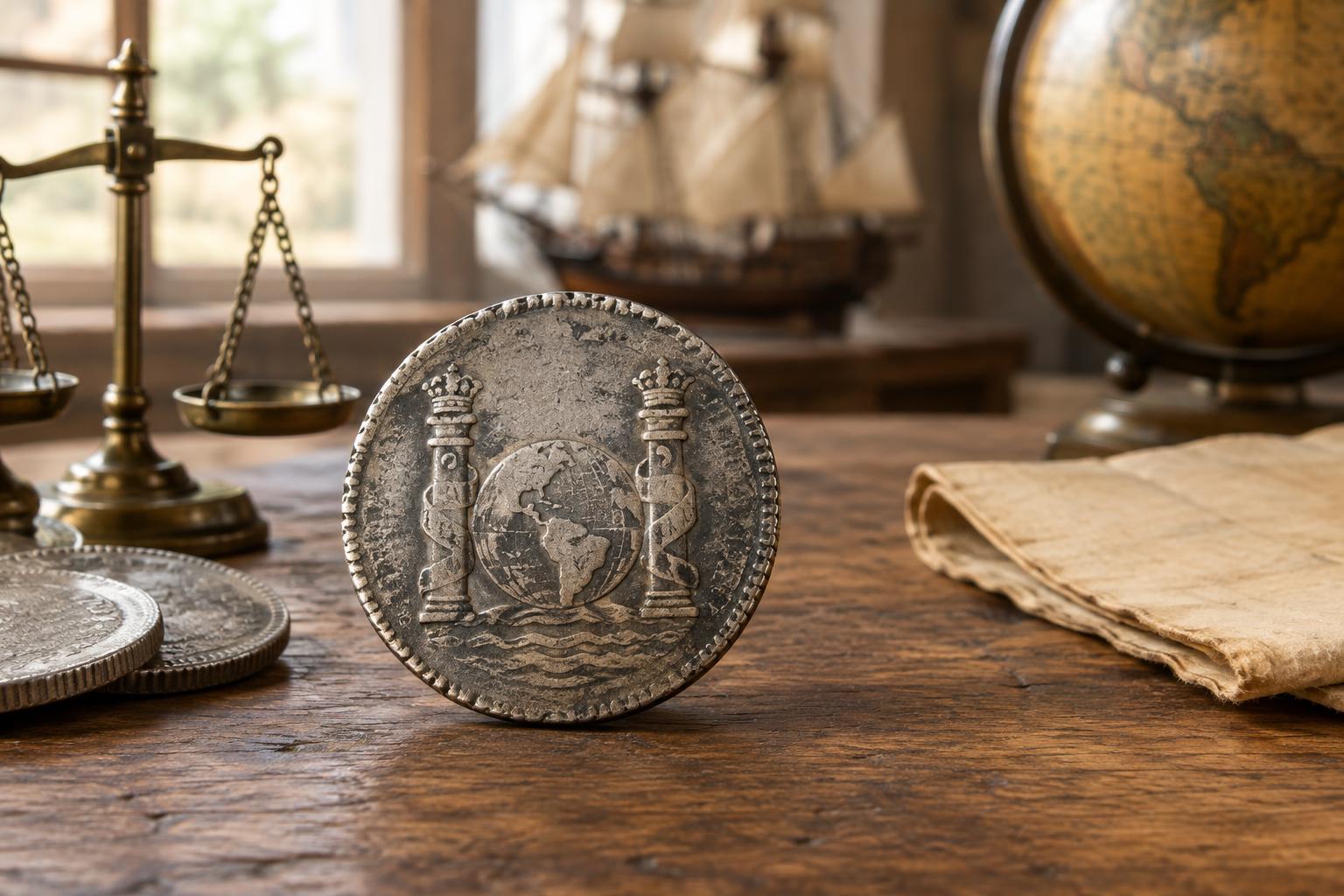
Later machine-made issues were more regular. Eighteenth-century pillar dollars, for example, show the crowned Pillars of Hercules with globes between them. Portrait issues show a Spanish monarch. These broad design groups give beginners a way to start identifying an eight reales before looking more closely at its date, mint mark and other details.
Some coins that circulated in Asia bear small stamped marks, often called chopmarks. Such marks are evidence of a coin’s later use or testing, though a mark by itself does not establish a complete travel history. Collectors should also remember that altered and counterfeit coins exist, so identifying an unfamiliar example may require more than matching its main design to a picture.
Reading the coin as a record of trade
An eight reales is a compact reminder that money can cross political borders when people find it useful and credible. Its silver, repeated production and far-reaching trade routes all contributed to its circulation. None of those factors alone explains every place it went or every exchange in which it was used.
For a beginner examining one, a good starting sequence is to note its overall design, look for a legible date and mint mark, and observe whether it appears hand-struck or machine-made. Record what is visible rather than guessing at missing details. Historical importance does not guarantee a particular market value: an individual coin’s authenticity, type and condition, as well as collector demand, all matter. Even without assigning a price, careful observation can connect a single coin to a much wider history.