Why acquisition records matter
It is easy to remember where a coin came from when it is new to your collection. Years later, a coin found at a show may look much like one received as a gift or bought from another collector. A short acquisition record preserves details that a holder or coin album usually cannot. It also helps you connect a coin to a receipt, an old envelope, or a conversation about how you obtained it.
The acquisition date is not the date on the coin. A coin dated 1942 might have entered your collection last month, while another coin with the same date has been in your family for decades. Keeping those facts separate makes your catalog easier to understand. A record of where you acquired a coin describes one step in its history; it does not, by itself, establish everywhere that coin has been.
Start with a few dependable fields
For each coin, assign a collection number that you can put in your catalog and on its storage label. Then record the acquisition date, the source, and the method: purchase, gift, trade, inheritance, or a coin you found in circulation. Identify the coin in enough detail to match it to the record later. Its country or issuing authority, denomination, date, and mint mark, if present, are a useful start. You can add photographs and more detailed descriptions as your collection grows.
Write the source as precisely as you comfortably can. A named dealer or sale, a coin show and seller, or the name of a relative may be more helpful than simply writing “bought” or “gift.” If a person’s name is private, use a consistent description such as “family gift” and keep any sensitive details in a separate place. For a purchase or trade, you may also want to note what you paid or exchanged, plus any shipping or fees you wish to track. Those figures document your transaction, not a coin’s present value.
Keep evidence and recollections distinct
A receipt, invoice, gift note, or original envelope can help support an acquisition record. Give each document a reference in your catalog, such as a file name or folder number, so you can find it without storing paper beside the coin. If an envelope has an old description or price, consider keeping it even after moving the coin to a more suitable holder. Photograph or scan documents when practical, and retain the originals if they are important to your records.
Not every detail will have written support. You might remember buying a coin at a particular show but not recall the seller. Record what you know and mark the rest as uncertain: “Purchased at a local show, seller unknown” is more useful than a confident guess. Likewise, if a seller describes earlier ownership, label that information as the seller’s account unless you have documentation for it. Being clear about the difference between a record, a recollection, and an assumption makes the catalog more trustworthy.
Choose a system you will maintain
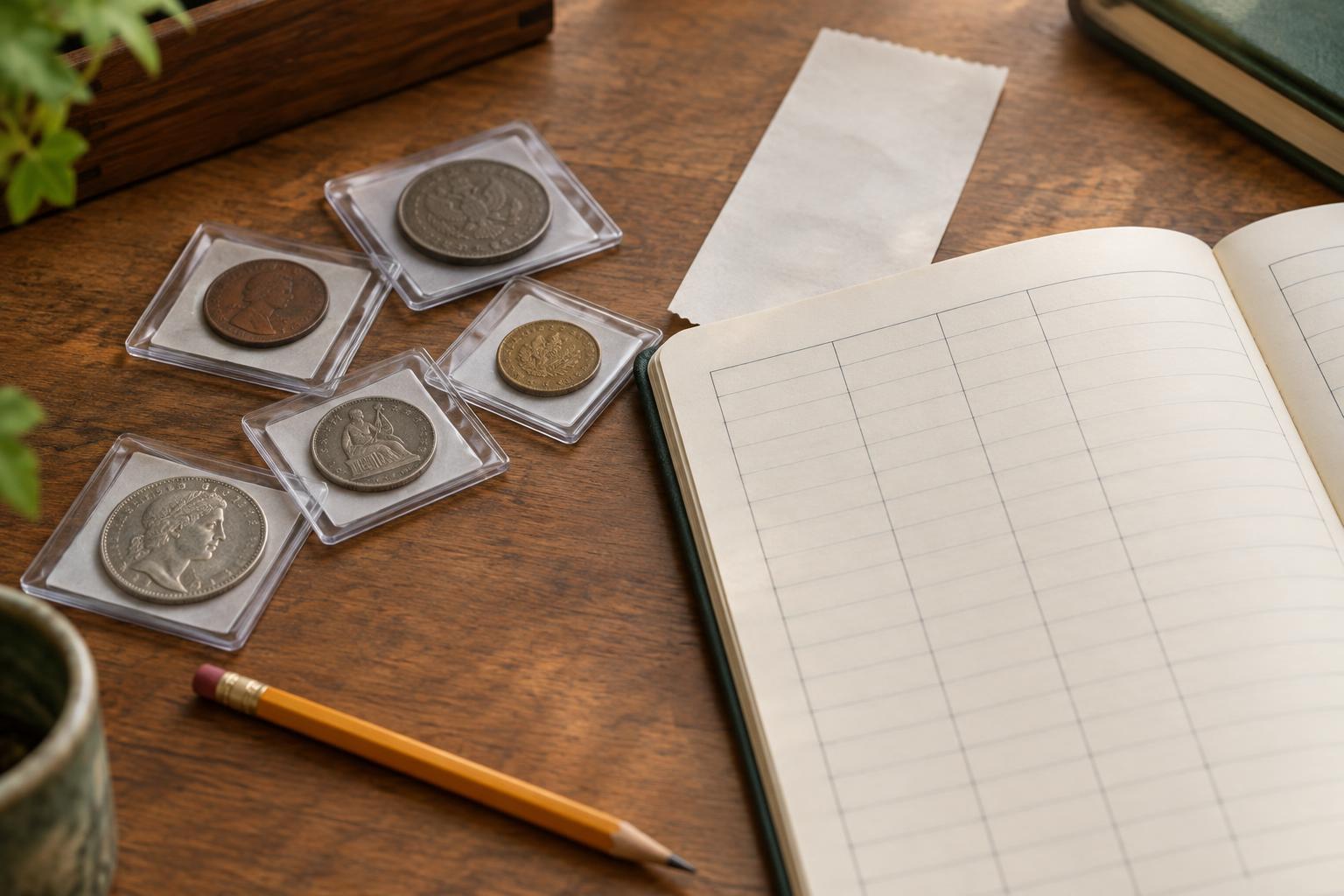
A notebook, spreadsheet, or cataloging app can all work. The best choice is one you can update when a coin arrives, before the details fade. Use the same field names throughout your collection, and choose one date format to prevent confusion. If you receive several coins together, note the shared transaction but give each coin its own collection number. For a mixed lot, you can record the total cost without inventing an exact purchase price for every piece.
Keep the catalog separate from the coins and make a backup if it is digital. A paper catalog can benefit from a copy stored elsewhere. Photographs are especially useful when you own coins of the same type: a clear image of each side can help you match a record to a specific piece. As you add information, preserve the original acquisition entry rather than silently replacing it. A dated correction or note shows how your understanding changed.
Make the record useful for the next owner
Acquisition notes can help you manage your collection, but they can also help if you later give, trade, or sell a coin. Record when it leaves your collection and, if appropriate, where it went. Keep private contact information out of any catalog copy you plan to share. When passing along a coin, you can include relevant paperwork or a concise summary of its documented history without making claims that the records cannot support.
You do not need a perfect catalog before you begin. Start with the next coin you acquire, then work backward through older pieces when you have time. For an unknown source or date, write “unknown” rather than leaving a blank that might look like an oversight. A modest, honest record kept consistently will be more useful than an elaborate system that is rarely updated.