Why standardize coins?
In the 19th century, neighboring countries often issued coins with different names, designs and metal specifications. A traveler or merchant crossing a border might need to determine not only a coin’s face value but also how much precious metal it contained. Coins made to the same specifications could be easier to compare and accept, even if they carried different national names.
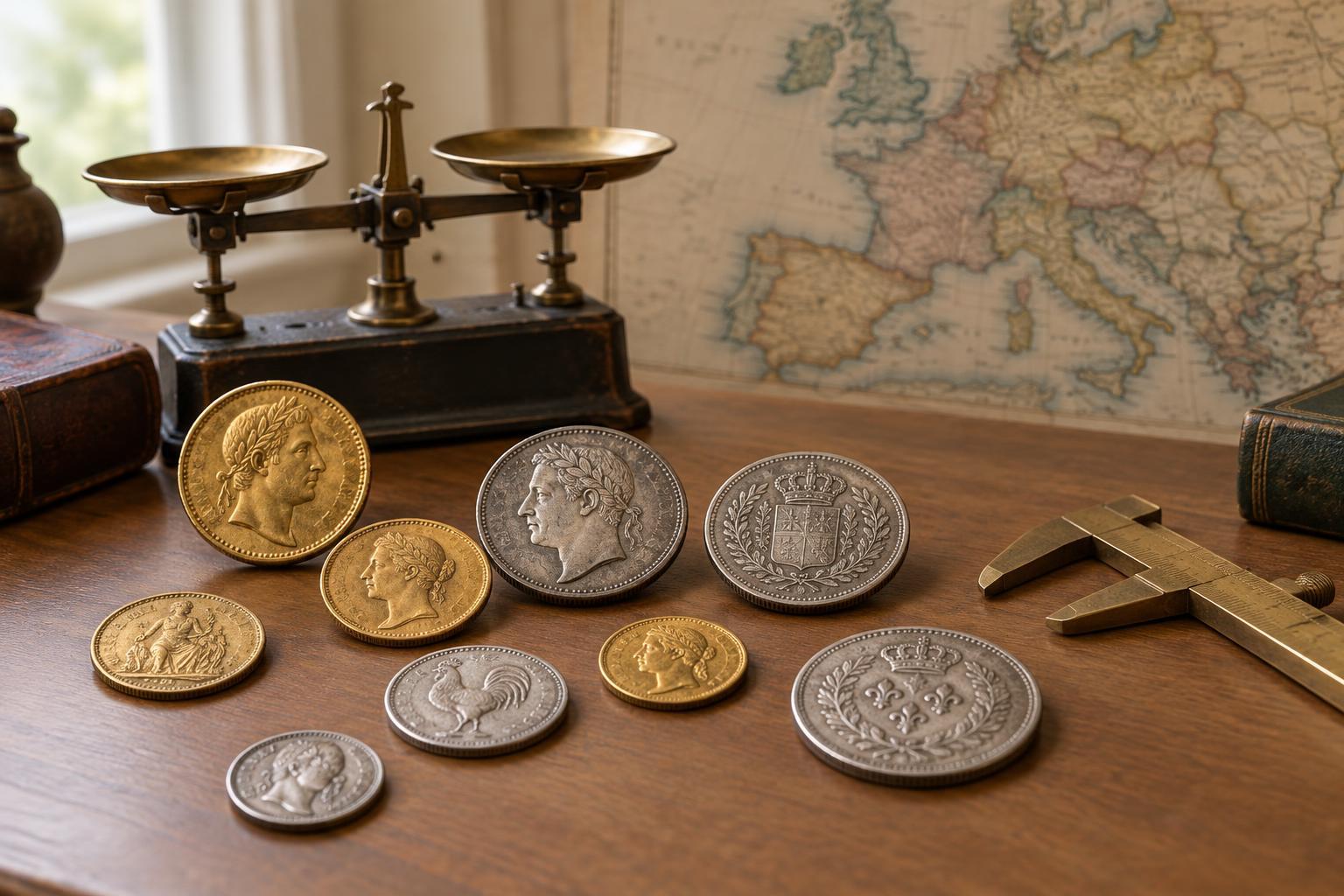
France, Belgium, Italy and Switzerland formed the Latin Monetary Union in 1865. Greece joined later. The agreement was an attempt to coordinate coinage, not to replace every member’s money with one currency. Each country kept its own designs and denominations, while following shared rules for specified gold and silver coins. That distinction makes the union especially interesting to collectors: a French franc, an Italian lira and a Swiss franc can tell different national stories while belonging to the same monetary system.
How the shared specifications worked
A central idea was that corresponding coins would have matching weights, metal fineness and values within the system. For example, a standard silver five-franc coin weighed 25 grams and was 90 percent silver. Five-lira coins could be made to the same specification. A gold 20-franc coin weighed about 6.45 grams and was also 90 percent fine; corresponding gold denominations followed the agreed standard.
Fineness describes the proportion of a coin that is precious metal. A coin marked by a specification of 90 percent silver contains silver mixed with other metal, commonly to make it more durable. Weight describes the whole coin, not just its silver or gold content. Together, weight and fineness help explain why coins with different portraits and inscriptions could be treated as equivalents under the agreement.
The system also distinguished between large silver pieces and smaller silver change. The smaller coins contained less silver relative to their face value and were subject to restrictions on issuance and acceptance. This was a practical way to keep everyday change available, but it also meant that not every silver coin played the same monetary role.
What made the system difficult to maintain?
The union’s rules had to operate in a world where the market relationship between gold and silver could change. When silver lost value relative to gold, a silver coin’s stated value could become more attractive than the value of its metal. That created pressure to produce and spend silver coins under rules originally designed for a different balance between the metals.
Members responded by limiting and eventually suspending the minting of standard silver five-unit coins. The result was a system that continued to use coins defined by both metals but relied increasingly on gold in practice. Coordination was difficult for another reason: national governments still controlled their own mints and coin issues. Shared specifications could make coins compatible, but they could not remove every difference in policy or every strain caused by changing metal prices.
The union endured in altered form for decades before it formally ended in the 20th century. Its history is best understood as a long-running effort to manage shared coin standards, rather than a single moment when all participating countries began or stopped using identical money.
What collectors can look for
A simple way to explore the union is to compare coins of the same intended value from different member countries. Look at the denomination, date, issuing country, portrait or national emblem, and edge design. Then compare the listed specifications for each coin type. Similar weights and fineness can reveal a connection that is not obvious from the artwork alone.
It is important to identify an individual coin before assuming it follows a union standard. Countries issued other coin types, and a familiar denomination does not guarantee identical composition across every year. Wear can also reduce a surviving coin’s measured weight. For an unfamiliar piece, begin with its country and date, then check its denomination and specifications against a reliable coin catalog.
The Latin Monetary Union offers a useful collecting theme without requiring a complete set. A few carefully identified coins can show both sides of its story: common technical standards and distinct national designs. Values and availability vary with condition, rarity and demand, but the historical connection is visible even in ordinary examples.