Trade needed more coins than the colonies produced
A customer in colonial North America might pay with a coin bearing a Spanish monarch rather than a British one. That was not necessarily unusual. The colonies traded across the Atlantic and within the Americas, but they had limited local coin production. British coins arrived through trade and personal travel, yet they did not always remain where they were needed. Merchants also sent money abroad to pay for goods, drawing coins out of local circulation.
The shortage was especially awkward for small purchases and making change. People adapted by using whatever forms of payment others would accept: foreign coins, locally issued paper money, credit, or goods. The mix differed by place and period. A foreign coin could be useful not because it had been officially designed for a colony, but because buyers and sellers recognized it and could agree on its value.
Why Spanish silver was so familiar
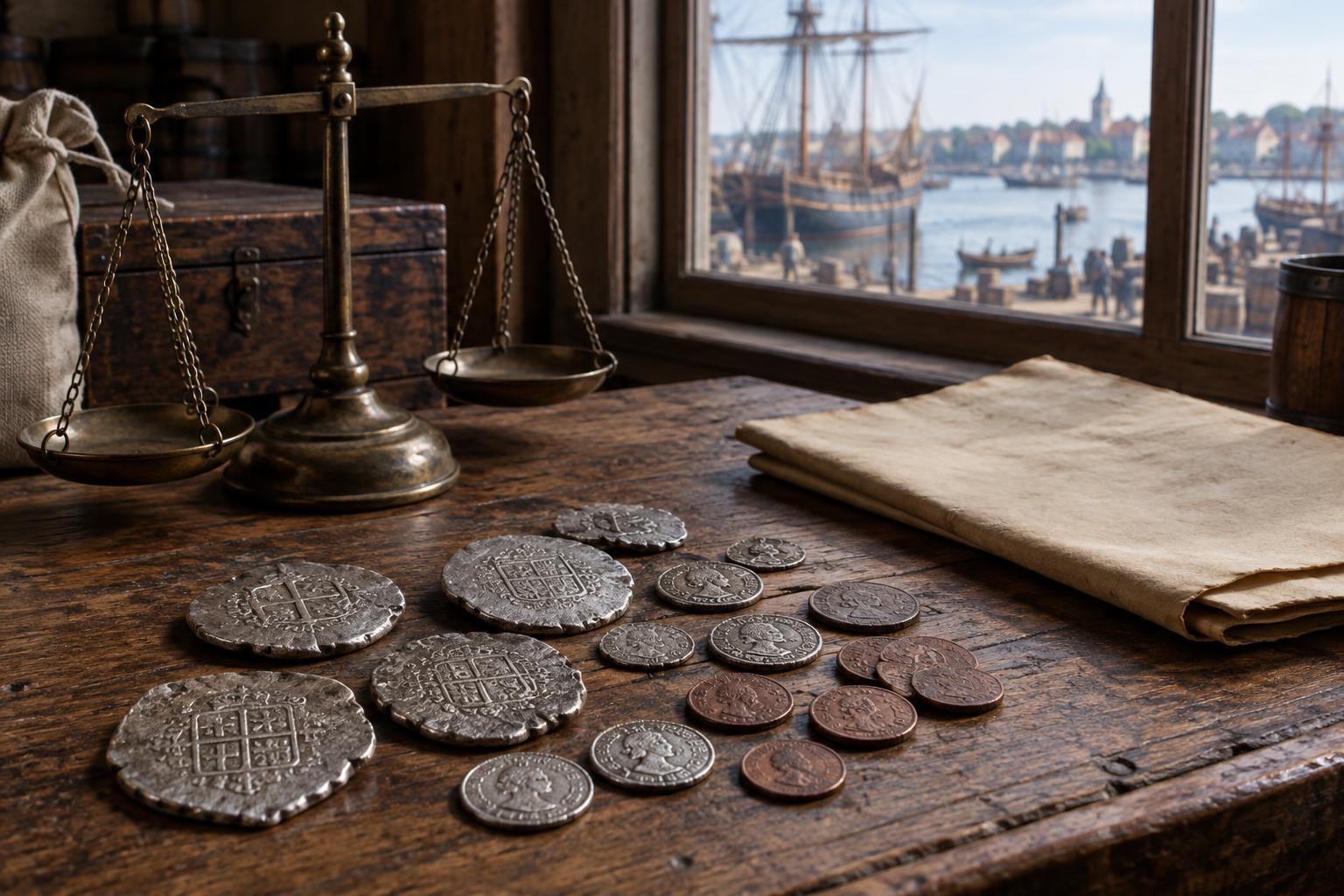
Spanish American mints produced silver coins that moved through extensive trade networks. Among the best known was the eight-real coin, often called a Spanish dollar or piece of eight. It was widely encountered in colonial North America, particularly where trade connected ports and settlements to the Caribbean and other parts of the Americas. Smaller Spanish denominations also helped with transactions that did not call for a full dollar.
A coin’s usefulness depended on more than the name stamped on it. People considered its silver content, weight, wear and likelihood of being genuine. Some coins were clipped, damaged or counterfeit, making acceptance less straightforward. Cut pieces of larger silver coins could serve as change in some circumstances, but they were not a tidy, universal system of equal-value pieces. Their practical worth still depended on what others were willing to accept.
Foreign did not mean only Spanish
Other coins crossed colonial North America’s many trade routes. Depending on the region and era, someone might encounter French, Dutch or Portuguese pieces alongside Spanish and British money. Connections with neighboring colonies, visiting ships, soldiers and merchants all helped coins travel beyond the places that issued them. A coin found in a colonial setting is therefore a clue to possible exchange, not proof of one particular journey.
This variety could make a pocketful of change confusing. Coins carried different denominations and designs, and a worn example might be difficult to identify at a glance. Local experience mattered: a familiar foreign coin could pass more readily than an unfamiliar one. Its acceptance might also vary between a busy port, where many kinds of money appeared, and a smaller community where people relied more heavily on credit or other arrangements.
One coin, different ways to count it
Colonists often kept accounts in pounds, shillings and pence even when they paid with coins issued elsewhere. An account entry was a way of stating what was owed; it did not guarantee that matching British coins would change hands. Instead, a payer and recipient could reckon a foreign coin in local money of account. Colonial authorities sometimes set rates for particular coins, while merchants and individuals had to consider a coin’s actual condition.
Those rates were not uniform across all colonies or all years. This is why a historical reference to a “shilling” needs context: it may describe a unit in an account rather than a specific silver coin. Paper money added another layer, since its acceptance and relationship to coins could change. To understand a transaction, it helps to ask where and when it happened, what form of money was offered, and how the parties counted it.
Reading the history on a surviving coin
For a collector, a foreign coin associated with colonial North America is a starting point for questions. Its date and design may identify the ruler under whom it was issued; inscriptions and mintmarks can help narrow down its origin. They cannot, on their own, establish that the coin circulated in a particular colony. Coins could travel for years, be kept as keepsakes or enter collections long after they were minted.
Look for reliable information about a coin’s type and compare its visible details with well-identified examples. Record what you know about where an example came from, and distinguish that documented history from guesses about its travels. Avoid cleaning a coin to reveal its details: cleaning can remove original surfaces and make identification harder. The lasting lesson of colonial coinage is that everyday money was shaped by trade, scarcity and trust, not simply by whose ruler appeared on the metal.